Vol. 3.2 October 1999
COMPARATIVE LAW AND THE INTERNETNormann Witzleb, Dieter Martiny, Ulrich Thoelke and Tim Frericks |
|
Readers are reminded that this work is protected by copyright. While they are free to use the ideas expressed in it, they may not copy, distribute or publish the work or part of it, in any form, printed, electronic or otherwise, except for reasonable quoting, clearly indicating the source. Readers are permitted to make copies, electronically or printed, for personal and classroom use. |
|
Contents
1. Introduction For their daily work, researchers working in a comparative or international context need a
mixture of different types of information, mainly on legislation, courts and case law, but also on
lawyers, studying law and legal literature. Research in specialised foreign law libraries or the
country itself is, however, rarely a possibility, especially when the question arises ad hoc. Lack
of access to foreign legal material and data has therefore, in the past, been a major hindrance to
comprehensive and up-to-date research. Modern information technologies help to overcome these problems and eliminate the
difference in time and space; theoretically, they give everyone access to the knowledge of the
whole world. It is, therefore, of great interest to use these new means for comparative research.
This article undertakes to give a survey of material on private law in Europe currently available
on the Internet(1), including some reflections on the usefulness of the Internet in its present state
and functionality for the comparative lawyer. On a more practical level, this article also aims to
portray and introduce the ‘virtuelle Rechtsvergleicher’, a research tool designed to accommodate
the specific needs of comparative lawyers and to allow structured and easy access to the most
informative legal sites in this field. Considering the vast amount of legal information available on the Internet and the nearly
unlimited variety in quality and character, it is hard to find reasonable criteria to structure it. The
most useful categorisation seems to be to distinguish between (1.) reference material, i.e. sites
that allow research on whether certain documents exist, where they were published and/or how
they can be obtained on paper, and (2.) content material, i.e. sources which give direct access to
electronic full-text versions of documents. The Internet has become a very dependable source of information about available printed
material and a convenient aid in establishing a bibliography on a research topic. It is possible to
find almost any information on books and legal journals on the net. Most European national
libraries (which are linked by the gateway Gabriel(2)) and academic libraries provide WWW
access to their catalogues allowing searches by formal criteria such as title, author, year of
publication as well as search by keywords. The catalogues of library networks (or meta-catalogues such as the German Karlsruher Virtuelle Katalog(3)) allow simultaneous research in all
participating libraries. The publishers’ or Internet bookshops’ catalogues as well as indices such
as the Verzeichnis lieferbarer Buecher(4) (index of available books in the German language) are
useful tools to remain up-to-date on the latest publications that may not yet be shelved in the
libraries. The increasing importance of the Internet also means that it has become hard to find a
government department, law faculty, research institute or pressure group without some sort of
Internet presence. Even though the amount of information given varies considerably, all home
pages contain some form of function or mission statement and facilitate contacts for further
information. It has therefore become much easier to get a picture of who is working on what,
who to ask for background information and how to obtain certain material. Also, for organisers
of conferences it has become common to provide dates and details of the proceedings, sometimes
even abstracts of the presentations to a wider public on the Internet. Most European countries now publish new legislation to some extent on the Internet. While
parliamentary statutes – the most important source of law – are usually published through their
parliamentary servers or through full-text online legal gazettes, the practice as to secondary
legislation differs widely. Some countries do not officially publish any secondary legislation,
while others offer extensive access either alongside the published statutes or on the government
or departmental servers. In many countries, legislation enacted prior to the establishment of online access is not
published in full text on the Internet, but can sometimes be traced by title and source.
Occasionally, these gaps are filled by private enterprise (e.g., from 1949 onwards, the
Bundesgesetzblatt(5) has been published as a facsimile version of the printed original). Apart from
the statutes themselves, parliamentary servers also often provide important information on the
legislative process, such as transcripts of parliamentary debates, committee reports or up-to-date
information on the current state of legislative proposals. Compilations of legislation and consolidated legislation are more likely to be found from
non-authoritative sources only. Apart from commercial databanks, it is often research institutes
or non-governmental organisations that provide this service. An important multi-jurisdictional
resource on legislation is, e.g., the former U.S. House of Representatives Internet law library(6)
(now hosted by a number of organisations such as LawGuru(7)); a further resource is the
International Constitutional Law (ICL)(8) databank hosted by the University of Wuerzburg, which
collates the texts of the constitutions and related information on a large number of countries. The presence of courts on the Internet has also rapidly increased in recent years. Most
constitutional courts and supreme courts have their own home page. Whether they contain more
than general information on the court and its function depends on the country and the importance
of judicial decisions in its legal system. In common-law systems, in particular in the USA and
Australia, comprehensive and well-structured access has become a matter of course. As with
legislation, lacunae in official publication – especially with older decisions – are often filled by
private databanks, with scope, speed, search options and method of access depending on the
provider. Decisions in specialised legal fields can also be found via universities, law firms or
organisations within the field concerned. The Internet is also of increasing importance as a mode of publication for legal literature of
interest to academics. However, the majority of established legal journals to date present only
their content pages online, while some others offer at least selected articles in full text as a
foretaste of their printed edition. Most online literature can therefore be found in new journals
that are – like the EJCL(9) – published exclusively as electronic journals. The speed and force with
which the publishing world changes under the influence of modern media have led to a further
increase in the number of law journals, particularly at university level. While they can usually be
found in lists of journals, it is even harder to keep track or get hold of the mushrooming non-refereed law journals and in-house magazines of legal firms and organisations. They frequently
report or comment on recent court decisions or review areas of law with special reference to the
needs of the practitioner and thus do not only serve as a forum for communicating with
(prospective) clients but also help to keep those interested informed about the latest
developments in certain legal fields. The publication of textbooks solely on the Internet is still rare, and will probably remain
so for the foreseeable future. This is probably not only for reasons of commerce and prestige, but
also due to the inconvenience of having to download and read or print vast amounts of text.
There are, however, laudable exceptions like the Zivilrecht online – Lehrbuch fuer
Oesterreichisches Buergerliches Recht (Textbook on Austrian Civil Law) by Professor Heinz
Barta from Innsbruck, which is advertised as the first student textbook on the Internet(10). Also, a
growing number of academic teachers use the Internet as a teaching aid. Offers range from
interactive learning tools to a simple presentation of lecture notes, exam papers and diagrams to
the students and to interested lawyers outside the university. These are, of course, primarily
designed to fit university law courses but – depending on their depth and quality – sometimes
allow more than a first overview of a certain field or problem. A good example of the latter are
Professor Werlauff’s publications on various subjects of Danish business law(11). In general, the publication of secondary material is still developing. At present, it is
usually still difficult to predict whether the chance of coming across relevant and useful material
will warrant the time spent perusing the net. In particular, ‘soft’ material not directed at the legal
academic but at a wider public can often only be traced by using search engines. For this kind of
background information, it can be worthwhile checking out the home pages of special agencies,
lobby groups, professional organisations or other entities that have an interest in disseminating
relevant information. The extent of publication of legal material depends heavily on the field of law in
question. However, there is an interaction between publishers’ and readers’ expectations in this
respect: One is more likely to find worthwhile material in areas of law which are anticipated to
be searched on the net. For this reason, publications concerning Internet or Information
Technology and the Law are naturally among the most readily encountered on the Internet. Less
inflationary but still likely to be found is material on transnational aspects of law, especially
international commercial, tax or intellectual property law. And in all fields of law, obviously the
most recent developments are the most likely to be covered by Internet publications. Apart from strictly legal material, the WWW also contains numerous other sites which
help to make the work of comparative lawyers simpler and more convenient. Examples of useful
tools are (general or legal) dictionaries such as Eurodicautom(12), a translation engine mainly for
European Union terminology (twelve languages), and directories of legal professionals
worldwide. Statistical background information on foreign jurisdictions can also be obtained from
national departments of statistics, which now publish some of their findings through the Internet. The increasing availability of legal information on the WWW has facilitated legal research
enormously. Research of foreign legal material is no longer dependent on travel, not bound to
opening times and is generally free of charge. (For those not fortunate enough to get free access
with a university server connection, telephone costs are still an issue, though.) There is a
tendency, however, for initially free databanks to turn fee-based when their offers have become
large enough and established in the user community. The first step is often research in the catalogues of foreign libraries to get an overview of
the literature available. Most university law libraries now allow guest access to their catalogues.
The English library network COPAC(13), the German Suedwestdeutscher Bibliotheksverbund(14)
(which includes the library of the Max-Planck Institute for Foreign Private and Private
International Law in Hamburg(15)), or the U.S. Library of Congress(16) have become convenient
points of entry for research on literature in foreign legal systems. The catalogues increasingly
employ uniform surfaces, thereby making research more user-friendly than former file-card,
microfiche or other systems which were often idiosyncratic and mysterious to outside users. While reference research still is one of the major strengths of Internet legal research,
content material is of ever increasing importance. Getting the full text of a document from the
Internet is most convenient for comparative work. Most Western countries and many of the new
democracies in Central and Eastern Europe now provide primary sources on the Internet. Foreign
parliamentary sites(17) can be especially useful because they often feature a databank for
parliamentary material such as official documents and/or parliamentary debates. This material,
formerly virtually inaccessible from outside the country concerned, can now easily be retrieved
and searched. More convenient and comprehensive research of what printed legal material there is and
where it can be found, and direct online access to the material itself are not the only aspects of
increased accessibility. Many associations, organisations and individuals use their home pages to
raise awareness of their functions and to promote their goals. Accessibility by e-mail allows
quick contact and enables the researcher to obtain first-hand information on the latest
developments or to verify the accuracy of information found elsewhere. The Internet also helps to bring down language barriers. With English being the language
of the web community, there has been a considerable increase in English-language publications.
Particularly for research in the smaller countries, language does not pose the barriers it used to
pose since these states have – to varying degrees – opened up and are publishing more
information in English, sometimes including special introductions into their legal systems or
state structure. Searchability is a major feature of most computer-assisted tools for legal research. Apart from
search engines that allow general web searches or searches of legal servers, the internal search
options of databanks and other major sites help to locate relevant material. But the success of a
keyword search depends as much on the scope and quality of the search tool as it does on putting
the query into meaningful and specific keywords. Keyword search can be employed for academic literature, for researching case law as well
as foreign legislation. For instance, the U.S. Library of Congress’s Thomas(18) server allows bill-tracking by topic, bill number or title. In the U.K., all Acts of Parliament (from 1996)(19) and all
Statutory Instruments (from 1997)(20) are not only available full-text, but are also searchable. It does not require more than space on a server’s hard drive and some knowledge of the relevant
software to publish documents on the Internet. On the one hand, this ease of publishing means
that the public can now benefit from material that formerly, due to cost or other reasons, usually
were not published. On the other hand, the decentralised and uncontrolled character of the
WWW means that there are also no limits to or checks on who publishes and what is published. In the pioneering days of the WWW, a great deal of information was provided by
enthusiastic lay people who saw the possibility of open access to legal material. However, even
though the information was often put online with the best intentions, the user was often left
without means to evaluate the reliability of the material offered. Inaccuracies were possible when
the electronic data were transcriptions of an originally printed source. The ubiquitous use of
disclaimers for accuracy of the material published was therefore understandable. This has changed considerably. Documents are now increasingly being published by the
authors themselves: Legislation can be drawn directly from parliamentary or governmental sites,
case reports are published by the courts, suggestions and reports for law reform by the proposing
body, minutes and memoranda by the organisers of conferences and meetings. This authenticity
ensures a very high degree of accuracy. For this reason, it is now increasingly acceptable to cite
from an electronic source (notwithstanding the specific problems of how to cite(21) a web
document correctly). The electronic nature of the publication does, however, have another
important drawback for academic research: Data can be removed from the Web just as easily as
they have been put onto it, they can be altered or they can be moved to a new location. It is,
therefore, by no means certain that material once found can be retrieved and/or checked at a later
date. For research, this means that it is essential not only to bookmark an interesting site but
often advisable to download or print relevant material before it is taken off the Web again. Printed information – except for newspapers – is often outdated especially when comparative work is
concerned with ongoing developments and reform processes. The convenience of Internet publishing has,
however, also made publications more timely and up to date. The time-span between writing and accessing
material has theoretically diminished to minutes compared to the months that used to pass from giving a
draft to the publisher, the printing process and, especially when foreign publishers were involved, delivering
the printed material abroad. This applies as much to legislative information on parliamentary sites as to court
reporting. The House of Lords(22), e.g., prides itself in publishing a judgment online usually within two hours
of delivery. With ‘perishable’ data, it is important that data are accurate not only at the time when it is posted
onto the net, but also at the time when it is accessed. As one is aware of the fact that many users rely on the
correctness of the material published, most official sites are constantly being updated. The date of the most
recent publication or update can indicate whether the site really is regularly checked and maintained(23). Apart
from that, the accuracy of material can now more easily be verified through e-mail correspondence, fax or
telephone directly with the publishers. The golden rule in comparative law – just behave as the natives do – applies equally to research on the
Internet. If the research is not to be left to pure chance, one has to know in advance where one could be
successful. This requires at least a certain familiarity with the information structure within the foreign
system. For simple research, it generally does not make sense to become a customer of a commercial service
such as WESTLAW, LEXIS, JURIS or CELEX. Therefore, the knowledge of how to use freely available
sites is crucial. Just as for general research on the Internet, search engines allow one to scan the Internet for relevant
information on law. Large search engines such as AltaVista(24) or Hotbot(25) use small programs called robots
or bots, which crawl ceaselessly through the WWW. Search engines create a file of every page they visit
and, in this way, compile huge databanks with keywords. Despite their enormous size and capacity, even the
most powerful engines register only about 16 to 20% of all WWW-pages (of approximately more than
800,000,000 today)(26). Depending on the preciseness of the searcher’s keywords, the result of the search can
either lead to accurate and comprehensive references of the available material or a jumbled list of irrelevant
links. To gain an idea of how to use general search engines there are useful manuals such as How to Search
the WWW: A Tutorial for Beginners and Non-Experts(27). Legal search engines enable the user to limit the search to some or all legal servers and, therefore, the
searches are likely to result in more relevant references. FindLaw’s Law Crawler(28) or the LawRunner Global
Index(29), a feature of the Internet Legal Resource Guide(30), are examples of multi-national legal search
engines, while Der Fahnder(31) allows searches on German legal servers only. For more structured searches it is often preferable to make use of legal indices. They arrange information by
type of document (legislation, case law, directories, etc.), by legal subject (e.g. international trade law,
commercial law, intellectual property law) and/or source of information (government, law schools, legal
organisations, law firms, etc.). Most link collections concentrate on their home jurisdiction; others, however,
also provide sections on foreign law. FindLaw(32) is one of the gateways for U.S. law, Mishpat-Net(33) for
Israel, Lexadin(34) for the Netherlands and the Juristisches Internetprojekt(35) of the University of Saarbruecken
for Germany. Multinational resource guides such as Hieros Gamos(36) or Guide to Law Online(37), prepared by the
U.S. Law Library of Congress for the Global Legal Information Network (GLIN), contain links to many or
virtually all countries, but the depth and comprehensiveness of the link pages vary; often their emphasis is
on U.S. material. Link pages that are geographically more limited but concentrate on certain law subjects can often be
found at sites of university libraries or institutes, legal associations, law firms or individual lawyers. Some of
these collections of links are excellent, especially when they are provided by specialists working in that field
who, therefore, make great efforts to create and maintain them. Against this background, the idea of the ‘virtuelle Rechtsvergleicher’ was born. It is designed to serve as a
reliable and comprehensive research tool for daily work in comparative law. The focus is on private law,
including commercial and consumer law, mainly in a European context. It gives access to already existing
legal sites in the Internet in such a way that a lawyer working in the field of comparative private law as well
as a law student can profit from its use. In almost every country of the world, there are similar, and often much more ambitious, projects. In
the United States of America there are, e.g., The World Wide Web Virtual Library(38), run by the Indiana
University School of Law, The Foreign and International Law Web(39) of Washburn University School of
Law Library and the global legal material provided by the Legal Information Institute(40) at Cornell Law
School. An example of a German site is the Rechtslinks,(41) a feature of the popular law portal Marktplatz-Recht. In the
Netherlands, the World Law Guide(42) and Tilburg Internet Law Library(43) provide similar resources; in Spain,
a project at the University of Gerona maintains a European and Comparative Private Law Page(44) – and the
list goes on. All links of the ‘virtuelle Rechtsvergleicher’ have been tested and evaluated by members (and
associates) of the Chair for Civil Law, Private International Law and Comparative Law at the European
University Viadrina Frankfurt (Oder)(45). This ensures that the quality and functioning of the selected links
have been ascertained in practice. The references given are kept as up to date as possible, even though the
pace of change and short life of legal Internet sites poses a constant challenge in this respect. If sites referred
to are not self-explanatory, they are usually commented on in order to inform the user of the information to
be expected. Small flags marking the language or languages of the sites are the only graphic symbol on the
link pages. This sparing use of graphic elements helps to keep loading times down to a minimum even in
times of slow net performance. There are introductory pages in English, French and Polish which, apart from specifying the scope
and functionality of the ‘virtuelle Rechtsvergleicher’, also provide translations of the basically uniform
categories pages. Therefore, the pages are also easy to use with little or no knowledge of German. At the
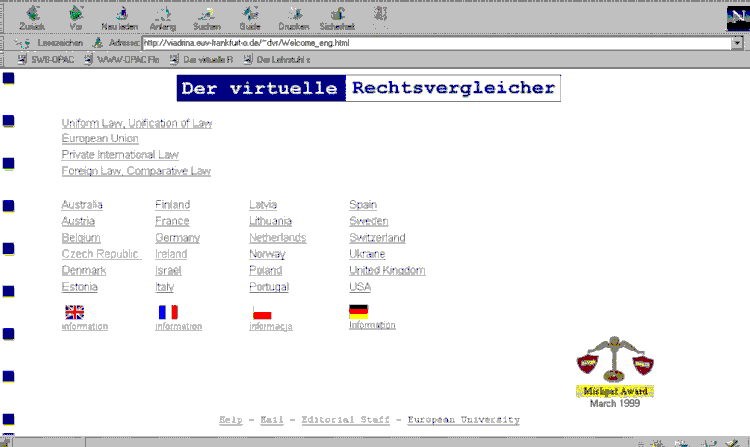
moment, an English version of the ‘virtuelle Rechtsvergleicher’ is being developed. The structure of the ‘virtuelle Rechtsvergleicher’ is designed to present the references in a straightforward
and user-friendly fashion: Any featured site can be accessed with no more than three mouse clicks. The
home page shows the legal fields and the countries covered.
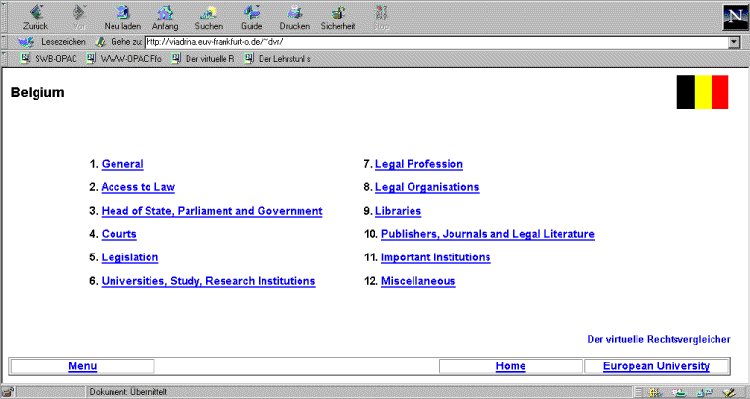
Clicking on one of these takes the user to the second level where the relevant category can
be chosen.
On the third level are the reference pages, which form the core of the ‘virtuelle Rechtsvergleicher’. They
contain the links and allow access to the most substantive and relevant legal sites in the category chosen. If
there is a page with a good list of links, reference is made to this page. The ‘virtuelle Rechtsvergleicher’ starts off with four legal fields comprising ‘Uniform Law, Unification of
Law’(46), ‘European Union’(47), ‘Private International Law’(48) and – most importantly – ‘Foreign Law,
Comparative Law’(49). The links featured on these pages are normally of a multinational character. The information available on the net in the field of ‘Uniform Law, Unification of Law’ is of varying
density and depth. There is, e.g., rich material on the Convention on the International Sale of Goods
(CISG)(50), while in other fields it is more difficult to find reliable information. Lists of international
organisations(51) like UNCITRAL(52) allow access to their sites, which contain material such as working papers
on draft conventions. The ‘European Union’ is today the most influential institution on the unification of law and is also
exceptionally well represented on the WWW. Generally, it is possible to get access to EU legislation and to
official documents of the European Commission(53) such as reports, green papers, white papers and other
documents. ‘Private International Law’ features links on the conflict of laws. Among the most prominent pages
here are those of the Hague Conference on Private International Law(54), which allow access to the Hague
Conventions(55) in English and French. ‘Foreign Law, Comparative Law’ mainly contains multinational or world-wide resources specifically
directed at comparative lawyers as well as non-legal aides for research in foreign law(56) (dictionaries, travel
guides, news). The pages on national jurisdictions feature resources on nearly all Member States of the European Union,
many Central and Eastern European states and some jurisdictions outside Europe: Australia(57), Austria(58),
Belgium(59), the Czech Republic(60), Denmark(61), Estonia(62), Finland(63), France(64), Germany(65), Ireland(66), Israel(67),
Italy(68), Latvia(69), Lithuania(70), the Netherlands(71), Norway(72), Poland(73), Portugal(74), Spain(75), Sweden(76),
Switzerland(77), Ukraine(78), the United Kingdom(79) and the United States of America(80). All references are grouped into the categories ‘General’, ‘Access to Law’, ‘Head of State, Parliament and
Government’, ‘Courts’, ‘Legislation’, ‘Universities, Study, Research Institutions’, ‘Legal Profession’, ‘Legal
Organisations’, ‘Libraries’, ‘Publishers, Journals and Legal Literature’, ‘Important Institutions’ and
‘Miscellaneous’. The basic idea behind the categories was that they should be meaningful and easy to work
with, but at the same time formulated so broadly that they accommodate the differences between the various
legal systems. They have, with some necessary adjustments, also been employed for the link pages on the
legal fields. Under ‘General’, general information on the country, statistical information and access to non-legal
servers are collected. ‘Access to Law’ is the main gateway to the national resources of each jurisdiction. Apart from lists
of legal search engines and indices, it contains links to legal databases and legal servers. If a country has an official home page, it can be found under ‘Head of State, Parliament and
Government’. This category also opens the path to all sorts of state information. As has been stated above,
parliaments usually provide the most reliable and relevant information on the legal process. Administrative
material (such as government reports, regulations, etc.) can often be found through the ministries or
departments concerned. The supreme courts of countries tend to have their home pages on the Internet, and these can be
found under ‘Courts’. It depends on the country to what extent court decisions are freely available. If the national legal gazette is already accessible online, it can be accessed through ‘Legislation’.
This category also contains links to non-state servers that provide access to primary and secondary
legislation. The category ‘Universities, Study, Research Institutions’ concentrates primarily on universities and
law faculties. The law faculties of foreign universities and special research institutions such as the Institute
for Advanced Legal Studies(81), often host a lot of material and have interesting further links. Information on
studying law in a particular country is especially useful for law students who intend to go abroad. ‘Legal Profession’ does not include links to single law firms but mainly to lists of law firms and,
where applicable, notaries. Organisations of the legal profession can also be found there. Their service pages
often provide excellent information and are worth checking out also by non-members interested in the latest
developments. All other organisations of lawyers as well as the national associations of law students can be
found under ‘Legal Organisations’. The home pages of bilateral lawyers’ associations provide information
on their upcoming events and trainee exchange programmes, and often present much material of interest for
comparative lawyers. The ‘Libraries’ page is the main gateway for reference research and also provides links to many legal
Internet resources. The ‘virtuelle Rechtsvergleicher’ contains links to the national libraries and important
academic libraries. The first important source of information under ‘Publishers, Journals and Legal Literature’ are the
lists of publishers. Publishers often provide their own law books catalogues on the Internet and give
information on books prior to their publication. Here one can also access the increasing number of legal
journals appearing on the Internet as well as find other information on literature which may help to establish
a bibliography on a research topic. ‘Important Institutions’ are, for instance, embassies, chambers of commerce and consumer
associations. They often provide useful information, e.g. on regulations on the entry of foreigners,
investment, consumer affairs, and so on. Finally, ‘Miscellaneous’ gathers together some extraordinary, not necessarily legal sites. The WWW is already one of the most important devices for research on comparative law. Its major strength
lies in facilitating research on where certain information is published and how it can be obtained.
Increasingly, legal material itself is available online. However, there is still no adequate representation of all
legal fields. In recent years, state servers (governments as well as parliament and courts) have been closing
the gap to private information services. The reliability and up-to-dateness of information is steadily improving but, as with all sources of
information, it is always important to use them with care. Finding information through search engines and
link collections has become easier, but the unstructured and uncontrolled nature of the WWW means that it
depends very much on the nature of information and search tools used whether one encounters the
information required within a reasonable amount of time. The ‘virtuelle Rechtsvergleicher’ is an easy-to-handle and well-structured tool for aiding WWW
research in the field of European private law. It presents the most important links to resources on uniform
law, comparative law, international private law and European Union Law, as well as legal material and
related information on more than twenty European jurisdictions, the USA and Australia. Notes 1. More accurately, the scope of this article is limited to the sites that are freely available on the World Wide
Web (WWW) as we do not purport to cover newsgroups (mailing lists or discussion groups) and commercial
databanks, even if they are accessible through the WWW. 2. http://portico.bl.uk/gabriel/de/welcome.html 3. http://www.ubka.uni-karlsruhe.de/kvk.html 4. http://www.buchhandel.de/sixcms/list.php?page=buchhandel_profisuche_frameset 5. Now a fee-based service. 6. See now http://www.lawguru.com/ilawlib/about.htm 7. http://www.lawguru.com/ilawlib/52.htm 8. http://www.uni-wuerzburg.de/law/home.html 10. http://info.uibk.ac.at/c/c3/c305/zivilonline/zivilonline.html 11. http://www.business.auc.dk/jura/werlauff/ 12. http://europa.eu.int/eurodicautom/login.jsp 13. http://copac.ac.uk/copac/ 14. http://www.swbv.uni-konstanz.de/CGI/cgi-bin/opacform.cgi 15. http://www.MPIPriv-HH.mpg.de/ 17. http://www.ipu.org/english/parlweb.htm 18. http://thomas.loc.gov/ 19. http://www.hmso.gov.uk/acts.htm 20. http://www.hmso.gov.uk/stat.htm 21. http://law.richmond.edu/JOLT/e-journals/citation_proposal.html 22. http://www.parliament.the-stationery-office.co.uk/pa/ld/ldjudinf.htm 23. If the date of the last update is not stated on the WWW page itself, it can be found by using the function ‘Document info’ of the Internet browser. 24. http://www.altavista.com/ 26. See Steve Lawrence and Lee Giles, Accessibility and Distribution of Information on the Web, <http://www.wwwmetrics.com/>. Background information on search engines can be found at http://www.searchenginewatch.com/ 27. http://204.17.98.73/midlib/tutor.htm 28. http://lawcrawler.findlaw.com/ 29. http://www.ilrg.com/nations/ 31. Now replaced by a fee-based service. 32. http://www.findlaw.com/ 33. http://mishpat.net/index.htm 34. http://www.lexadin.nl 35. http://www.jura.uni-sb.de/internet/ 36. http://www.hg.org/ 37. http://www.loc.gov/law/guide/index.html 38. http://www.law.indiana.edu/v-lib/ 39. http://www.washlaw.edu/forint/forintmain.html 40. http://www.law.cornell.edu/world/ 41. http://www.marktplatz-recht.de/rechtslinks 42. http://www.lexadin.nl/wlg/ 43. http://till.uvt.nl/ 44. http://civil.udg.es/epclp/ 45. http://viadrina.euv-frankfurt-o.de/~intrecht/ 46. http://viadrina.euv-frankfurt-o.de/~dvr/laender/rv/rv.htm 47. http://viadrina.euv-frankfurt-o.de/~dvr/laender/eu/eu.htm 48. http://viadrina.euv-frankfurt-o.de/~dvr/laender/ipr/ipr.htm 49. http://viadrina.euv-frankfurt-o.de/~dvr/laender/ar/ar.htm 50. http://viadrina.euv-frankfurt-o.de/~dvr/laender/rv/rv_05.htm 51. http://viadrina.euv-frankfurt-o.de/~dvr/laender/rv/rv_03.htm 53. http://europa.eu.int/comm/index.htm 55. http://www.hcch.net/index_en.php?act=conventions.listing 56. http://viadrina.euv-frankfurt-o.de/~dvr/laender/ar/ar_12.htm 57. http://viadrina.euv-frankfurt-o.de/~dvr/laender/au/au.htm 58. http://viadrina.euv-frankfurt-o.de/~dvr/laender/at/at.htm 59. http://viadrina.euv-frankfurt-o.de/~dvr/laender/be/be.htm 60. http://viadrina.euv-frankfurt-o.de/~dvr/laender/cz/cz.htm 61. http://viadrina.euv-frankfurt-o.de/~dvr/laender/dk/dk.htm 62. http://viadrina.euv-frankfurt-o.de/~dvr/laender/ee/ee.htm 63. http://viadrina.euv-frankfurt-o.de/~dvr/laender/fi/fi.htm 64. http://viadrina.euv-frankfurt-o.de/~dvr/laender/fr/fr.htm 65. http://viadrina.euv-frankfurt-o.de/~dvr/laender/de/de.htm 66. http://viadrina.euv-frankfurt-o.de/~dvr/laender/ie/ie.htm 67. http://viadrina.euv-frankfurt-o.de/~dvr/laender/il/il.htm 68. http://viadrina.euv-frankfurt-o.de/~dvr/laender/it/it.htm 69. http://viadrina.euv-frankfurt-o.de/~dvr/laender/lv/lv.htm 70. http://viadrina.euv-frankfurt-o.de/~dvr/laender/lt/lt.htm 71. http://viadrina.euv-frankfurt-o.de/~dvr/laender/nl/nl.htm 72. http://viadrina.euv-frankfurt-o.de/~dvr/laender/no/no.htm 73. http://viadrina.euv-frankfurt-o.de/~dvr/laender/pl/pl.htm 74. http://viadrina.euv-frankfurt-o.de/~dvr/laender/pt/pt.htm 75. http://viadrina.euv-frankfurt-o.de/~dvr/laender/es/es.htm 76. http://viadrina.euv-frankfurt-o.de/~dvr/laender/se/se.htm 77. http://viadrina.euv-frankfurt-o.de/~dvr/laender/ch/ch.htm 78. http://viadrina.euv-frankfurt-o.de/~dvr/laender/ua/ua.htm 79. http://viadrina.euv-frankfurt-o.de/~dvr/laender/uk/uk.htm 80. http://viadrina.euv-frankfurt-o.de/~dvr/laender/us/us.htm 81. http://ials.sas.ac.uk/
|